Accurate, Robust and Efficient Terrestrial Laser Scan Alignment (2023-2024)
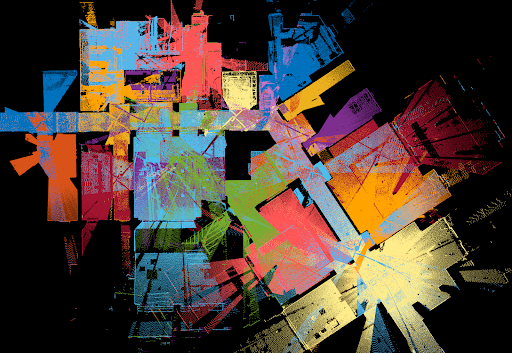
We proposed a new registration scheme that leverages directed acyclic graphs to represent scan connectivity, and developed a viewpoint-aware GICP algorithm and a multiview GICP registration algorithm for millimeter-level accurate scan alignment.
Related Publications: Accurate and Robust Scan Alignment via Viewpoint-aware Generalized ICP and Multiview Registration with Directed Acyclic Graphs, T-RO 2024 (under review).
Advisors: Dr. Ali-Akbar Agha-Mohammadi, Prof. Konstantinos Karydis
LiDAR Odometry and Mapping in Agricultural Environments (2022-2023)
We proposed an adaptive LiDAR odometry and mapping framework for robust operation in unstructured agricultural environments. The proposed system can handle jerky motion and aliasing features across diverse planting environments and provide centimeter-level localization and mapping accuracy.
Related Publications: Adaptive LiDAR Odometry and Mapping for Autonomous Agricultural Mobile Robots in Unmanned Farms, COMPAG 2024; Multimodal Dataset for Localization, Mapping and Crop Monitoring in Citrus Tree Farms, ISVC 2023.
We proposed an efficient multi-modal keypoint detector that can extract both geometry-salient and color-salient keypoints in a colored point cloud, leveraging centroid distance saliency measures in 3D space and color space, as well as a multimodal non-maximum suppression algorithm.
Related Publications: Centroid Distance Keypoint Detector for Colored Point Clouds, WACV 2023.
Online Coverage Planning in Unknown Environments (2020)
We proposed a hierarchical, hex-decomposition-based coverage planning algorithm for unknown, obstacle-cluttered environments. The proposed approach ensures resolution-complete coverage, can be tuned to achieve fast exploration, and plans smooth paths for Dubins vehicles to follow at constant velocity in real-time.
Related Publications: Online Exploration and Coverage Planning in Unknown Obstacle-Cluttered Environments, RAL 2020; Multi-robot Field Exploration in Hex-Decomposed Environments for Dubins Vehicles, ROBIO 2019
Analysis of Ground Effect for Small-scale UAVs (2019)
We investigated how the behavior of small-scale Unmanned Aerial Vehicles (UAVs) is influenced by the system’s close proximity to the ground/rigid surfaces both at hover and in forward flight.
Related Publications: Analysis of Ground Effect for Small-scale UAVs in Forward Flight, RAL 2019
Distributed Multi-robot Formation Control (2018)
We implemented a consensus-based distributed optimization algorithm on five Pioneer3-AT robots and completed trajectory tracking, formation control, and rendezvous tasks.
Related Publications: Senior Design Project (Undergraduate Thesis)
Advisors: Prof. Wei Ren, Prof. Konstantinos Karydis
Autonomous Aerial Patrol and Surveillance based on UAVs (2015-2017)
We developed three generations of quadrotor-based autonomous UAV platforms (F330, DaYa550, M100) as well as an Android App and a ground station for autonomous aerial patrol and surveillance. We implemented a variety of algorithms for object detection (YOLOv2), pedestrian tracking (KCF) and anomaly detection (supervised learning).
Related Competitions and Awards: The 15th Challenge Cup Competition (Second Prize @ Xidian University); The 2nd China ‘Internet Plus’ Entrepreneurship Competition (First Prize @ Xidian University); National College Students’ Innovation Program (Outstanding Project)


 Hanzhe Teng
You must be logged in to post a comment.